
Some people think immersive mystery nights require designer props, theatrical equipment, and a storage closet full of vintage suitcases. Not true. You can build a world so convincing your guests forget they’re in your living room, and you can do it for less than the cost of takeout.
Immersion isn’t about money. It’s about mood. Details. The tiny touches that make people whisper, “Wait… did they actually plan all this?”
If you’ve seen the simple setup ideas in the guide for hosting a family-friendly Mystery Night, you know you don’t need much to get rolling. But today we’re going bigger. We’re building worlds.
And we’re doing it on a shoestring budget.
The Secret Weapon: Thrift Stores In Nice Neighborhoods
Let me tell you the truth about thrift stores in high-income zip codes. They’re gold mines. Not metaphorical gold mines. Actual “why is this antique-looking brass lantern only $4” gold mines.
Goodwill. Salvation Army. Local church thrift shops. Hit the ones in nice suburbs and you’ll find props that look like they wandered off a movie set.
Look for:
- Faux leather-bound books
- Wooden boxes with mysterious hinges
- Old maps
- Glass bottles (your new “potion” vessels)
- Vintage scarves, hats, satchels
- Lanterns, candlesticks, frames
Every item becomes a story hook. A character detail. A clue container. A piece of world-building that cost you less than a latte.
Build A Story-First Space
World-building starts with a single question: what should the room *feel* like? Not look like. Feel like.
Do you want the nervous buzz of a late-night train car? Use low lamps and shadowy corners.
Prefer an archaeological dig? Scatter rope, aged paper, and a dusty color palette.
When you think in feelings instead of decorations, you actually spend less money.
Use Lighting To Fake A Bigger Budget
Fancy props are great, but lighting does most of the heavy lifting.
Try:
- Table lamps instead of overhead lights
- Clip-on LED candles from the thrift store or Dollar Tree
- Flashlights for dramatic reveals
- Warm-toned bulbs for cozy scenes
Lighting creates immersion faster than any decor purchase. Dim the lights 20 percent and suddenly your home feels like a secret base, not a kitchen with fingerprints on the fridge.
Repurpose Regular Items As “Artifacts”
You don’t need themed props. You need props that *could* be themed.
A few dollar-store or Goodwill transformations:
- A wooden bowl becomes the expedition’s artifact basin
- An old lock becomes the “mysterious relic clasp”
- A scarf becomes evidence
- A chipped teacup becomes a clue container
It’s amazing how quickly players accept a normal household item as magical, historical, or suspicious if you simply treat it with gravity.
Create Micro-Worlds In Each Corner
You don’t need to transform the whole room. Just carve out zones.
- The Briefing Table
- The Archives Corner
- The Forensic Desk
- The Traveler’s Station
A few props and a sign can turn a corner into a whole piece of your world. Guests adore this. They wander. They investigate. They whisper conspiratorially in spaces you never expected.
Before we keep going with more budget-friendly tricks, here’s a resource that helps you dip your toes into mystery hosting without committing to a giant setup. It’s a quick, playful warm-up mystery designed for small groups. Perfect for testing props, pacing, and immersion on a small scale.
Click HereCreate Atmosphere With Paper (Seriously)
Paper is wildly underrated.
- Burn the edges of printer paper to make “ancient documents”
- Roll pages into scrolls tied with ribbon
- Print fake letters on heavy cardstock
- Aging with tea bags gives instant “found in a tomb” energy
This costs pennies and looks incredible.
Lean Into Texture Over Accuracy
Adventure worlds don’t need to be historically correct. They need texture.
Texture feels immersive. Texture tells your brain, “This place has layers.”
Try:
- Rough rope
- Natural fabrics
- Faux fur scraps
- Metal trinkets
- Stone-like objects
You can find all of these at thrift stores or craft bins. Players won’t care if the “ancient rune stone” is actually a paperweight from OfficeMax.
Use Soundscapes Instead Of Expensive Decor
You know why movie sets feel real? Sound.
Add light jungle ambience. Train rumbling. Ocean waves. Library whispers. You can find free sound loops anywhere.
Sound covers decor gaps, absorbs awkward silence, and fills the room with atmosphere even if your furniture isn’t theme-matching.
Design a Single “Hero Prop”
You don’t need lots of props. You need one unforgettable one.
Examples:
- A giant old key
- A puzzle box
- A weathered map
- A chest with a combination lock
One showstopper prop becomes the centerpiece of immersion and distracts players from noticing the affordable choices around it.
Make Clues Feel Physical
A printed clue is fine. A physical clue is better.
- Wrap clues in twine
- Hide messages in bottles
- Use envelopes stamped dramatically
- Create “found artifact tags” with fake catalog numbers
Cheap. But players suddenly treat the game like an archaeological excavation.
Let Characters Shape The World
You don’t have to decorate much if the players do the world-building for you. Give characters bold prompts. Unusual items. Dramatic backstories.
Some ideas from the post on assigning characters for a Mystery Night show how quickly personality creates immersion.
If people *act* like they’re in another world, the room naturally transforms.
Organize Your Props In Plain Sight
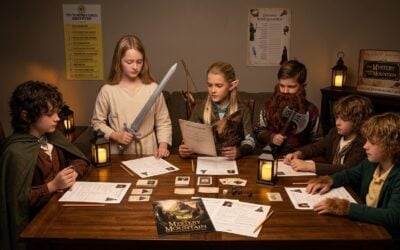
Adventurers love organized clutter. A table filled with:
- Old books
- Lanterns
- Rope
- Field notes
- Magnifying glasses
Done. That’s your entire “Explorer Base Camp.” Looks intentional. Costs almost nothing.
Use Costumes To Cheat The Immersion Curve
Costumes do half the world-building for you.
Your players:
- Wear hats from Goodwill
- Borrow scarves
- Use thrifted jackets
- Repurpose school play costumes
Suddenly the world feels populated with characters instead of guests. Costumes override decor every time.
Use Height And Layers To Build Depth
Even a few risers or stacked boxes make the room feel more visually interesting. Add crates under tables. Put props at different heights.
Your guests interpret height variation as “detail,” even if the layers are made from $2 Goodwill crates.
Make Your Space Smell Like The World
No need to get dramatic. Just subtle scents:
- Leather scent for a Wild West mystery
- Cedar or pine for an expedition
- Vanilla for a cozy vintage train
Tiny scent cues go straight to the brain’s story center.
Turn Your Walls Into Storyboards
You can do this with tape and a printer.
- Maps
- Fake telegrams
- Evidence charts
- Character sketches
Even if the rest of the room is normal, a wall full of “story clues” feels immersive.
Let Lighting Control The Mood Beats
This is the cheapest trick with the highest impact.
Dim the lights during reveals. Turn them up during frantic clue searching. Use a single spotlight (aka a desk lamp) to highlight important moments.
Instant drama.
End With A Reveal That Uses Your Props
When the reveal incorporates the props players have been interacting with, the immersion skyrockets. The rope, the lantern, the map, the clue bottle. All of it suddenly clicks together.
That’s when your guests forget they’re in suburbia and not a jungle, train car, museum, or frontier town.
Immersion Isn’t Expensive. It’s Intentional.
You don’t need Hollywood budgets. You need thrift store treasures, a few lighting tricks, and props with personality. Build feelings, not sets. Build moments, not displays.
And if you want to test how immersive your group’s energy can get, here’s a simple warm-up mystery that will give you the confidence to plan a full adventure.
Click Here
0 Comments