
Most people who buy a murder mystery game get exactly what they paid for: a game. Papers, characters, clues, a reveal at the end. And it’s fine. People enjoy it. But fine is not the same as memorable, and there’s a gap between running a mystery and hosting an event that people talk about afterward. The gap isn’t money. It’s not even that much effort. It’s mostly framing — the small decisions you make before anyone walks through the door that signal to your guests that tonight is different.
The psychological shift you’re going for is subtle but real. When guests feel like they’ve arrived somewhere rather than just shown up to your living room, they play differently. They lean in. They take their character more seriously. They’re more willing to be a little dramatic, a little deceptive, a little more invested in the outcome. None of that happens because you bought expensive decorations. It happens because the experience was staged with intention, and people can feel the difference even when they can’t explain it.
It Starts Before Anyone Arrives
The event begins the moment you send out the invitations, not the moment guests walk in. This is one of the most underused tools in mystery hosting, and it costs nothing to get right. An invitation that says “you’re invited to a murder mystery party” is fine. An invitation that says “you have been summoned to the Grand Gilded Express for an evening of fine dining — and possible intrigue” is an event. The language you use in that first communication sets the register for everything that follows.
If you’re sending character assignments ahead of time, which is genuinely worth doing, frame those the same way. Include a line or two of in-character flavor text with the role packet. “Your character, the Countess, has been traveling with a secret she cannot afford to have discovered…” That small addition costs about two minutes and changes how seriously your guests engage with their role before they even arrive. People who feel like they’ve been cast in something will show up ready to play it.
The Room Does More Work Than You Think
You don’t need a fog machine and a rented tuxedo to create atmosphere. What you actually need is intention in a few specific areas, because guests notice the deliberate choices even if they’re small. Lighting is probably the single highest-impact variable in the room, and it’s cheap to adjust. Dimmer switches, candles, a few Edison bulb string lights from Amazon — the right lighting for a mystery night doesn’t require a budget, it just requires turning off the overhead fluorescents that make everything feel like a dentist’s office.
Music is the other thing that works quietly in the background and does enormous atmospheric lifting when it’s right. A jazz playlist set to low volume, something instrumental with a slightly old-world feel, creates ambient tension without distracting anyone from the actual game. If the setting is a train, find a Spotify playlist with some 1920s big band energy. If it’s a Paris art heist, lean into something cinematic and French. The music doesn’t need to be perfectly curated — it just needs to not be wrong, and “wrong” is mostly just silence or something that breaks the mood entirely.
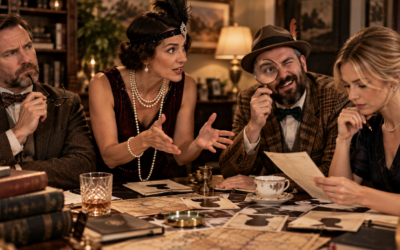
For the physical space, a little goes a long way. A single prop on a side table — a magnifying glass, a sealed envelope with “EVIDENCE” written on it, a candelabra — tells guests more about the tone of the evening than an hour of explanation would. Turning your house into a mystery setting is genuinely easier than most people assume, because the goal isn’t to transform the space entirely — it’s to give the eye somewhere interesting to land.
How You Open the Night Changes Everything
The single most common mistake first-time hosts make is starting the game too fast. Guests arrive, get handed a character sheet, and are immediately expected to be “in it” before they’ve even taken their coat off. That transition is jarring, and it leads to the slightly awkward first twenty minutes where nobody quite knows how serious to be.
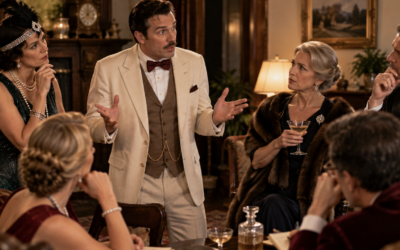
Give the evening a proper opening instead. Gather everyone, stay loosely in character yourself, and set the scene with a sentence or two read from the host materials. Acknowledge the setting. Say something like, “Welcome aboard the Grand Gilded Express — something terrible has happened, and none of us are leaving until we find out who’s responsible.” That’s it. Thirty seconds of intentional framing and the room shifts. People start looking at each other differently. The game has officially begun, and it began with a moment rather than a shrug.
If you’re worried about running the host role smoothly, know that you don’t need to perform to host well. The best hosts are the ones who stay calm, keep the pacing moving between rounds, and know when to let the players take over. The structure in a well-designed game does most of the heavy lifting — your job is to hold the container, not fill it.
Match the Game to the Vibe You’re Creating
The atmosphere you’re building should connect to the actual game you’re playing, which sounds obvious but gets ignored more often than you’d think. If you’ve spent two hours setting up a sophisticated dinner party aesthetic with linen napkins and a real cheese board, and then you run a slapstick comedy mystery that keeps breaking the fourth wall, the tonal mismatch deflates everything you built. Pick the game first, then build the atmosphere around it.
The Grand Gilded Express is a great example of a game that comes with its own built-in atmosphere — the luxury train setting gives you an automatic visual and tonal reference point that guests immediately understand. Dress it up with a few train-themed props, serve dinner in courses to mirror the dining car experience, and the setting practically decorates itself. Similarly, Murder at Copper Gulch gives you a completely different palette to work with: Western, dusty, old-saloon energy that invites entirely different costuming and food choices. The game theme is your creative brief — follow it and the event cohesion comes naturally.
The Details That Actually Make People Feel It
A few small additions consistently separate a game night from a genuine event. Name cards at seats, written in character names rather than real names, cost about four minutes and a piece of cardstock and immediately make the table feel like a stage. Serving food that loosely fits the theme — French onion soup for a Paris-set mystery, cornbread for a Western one — gives the meal a reason to exist beyond just feeding people. And the transition from dinner to gameplay is worth thinking through, because that moment is where events either accelerate into something exciting or stall out into confusion.
The truth is that mystery nights become real events when the host treats them like one. Not obsessively, not expensively, but with the same basic care you’d put into any occasion you wanted people to remember. The game gives you the structure. The atmosphere gives it the feeling. And the feeling is what people take home.

0 Comments