
Two Party Ideas That Sound Similar but Feel Completely Different
If you have ever planned a family gathering, church event, birthday party, youth group night, or long weekend hangout, there is a decent chance you have looked at both scavenger hunts and murder mystery games and thought, “Aren’t these basically the same thing?”
Not really.
They both involve groups. They both involve movement, clues, laughter, confusion, snacks disappearing too quickly, and at least one person taking things wildly too seriously. Every scavenger hunt somehow produces a self-appointed Navy SEAL commander who starts yelling things like, “CHECK THE GARAGE AGAIN!” while holding a flashlight they absolutely did not need.
Still, the overall experience ends up being very different.
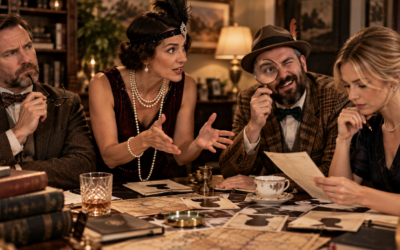
Scavenger hunts are usually fast, energetic, and task-oriented. Mystery games lean more immersive. You are not just solving clues. You are becoming part of a story. Instead of hunting for hidden plastic eggs behind couch cushions, you are accusing your brother-in-law of stealing priceless artwork while he desperately tries to defend himself in a fake French accent.
Honestly, both are fun. We are not anti-scavenger hunt around here. But they scratch different social itches.
A scavenger hunt feels like a sprint.
A mystery game feels like stepping into a movie for a couple hours.
The Biggest Difference Is What People Remember Later
This is the part that surprised us when we first started hosting mystery nights through our church’s marriage ministry. We expected people to enjoy the game while it was happening. That part was obvious.
What we did not expect was how often people kept bringing it up weeks later.
Someone would walk into church and immediately joke about how their spouse falsely accused them during the game. Another couple would still be arguing over who ignored an obvious clue. One guy became permanently associated with the ridiculous fake mustache he wore during the event. Poor man can never escape it now.
That tends to happen with roleplaying experiences.
Scavenger hunts create excitement in the moment. Mystery games create stories people retell.
Part of that comes from the character element. In a scavenger hunt, you are mostly yourself trying to complete objectives. In a mystery game, you temporarily become somebody else. That creates emotional distance in a good way. Quiet people suddenly become dramatic suspects. Competitive people turn into amateur detectives. The normally reserved friend starts publicly accusing strangers with the confidence of a daytime courtroom TV host.
It is incredible.
Scavenger Hunts Usually Depend More on Physical Space
One practical advantage mystery games have is flexibility.
A scavenger hunt often needs hiding spots, movement pathways, outdoor access, multiple rooms, or setup logistics that can become annoying surprisingly fast. Especially with kids. Especially with weather. Especially when somebody accidentally hides a clue so well that even the host cannot find it later.
Now everybody is standing in the laundry room searching for an envelope that apparently entered another dimension.
Mystery games work differently. Most can happen entirely in one room if necessary. People naturally spread out into conversations anyway, but the game itself does not depend on physical exploration nearly as much.
That is one reason smaller-space groups tend to enjoy games like The Louvre Heist. It works particularly well for tighter living rooms, apartments, condos, or homes where rearranging furniture sounds exhausting.
You are creating social movement instead of physical movement.
Huge difference.
Want to Test a Mystery Night Before Organizing a Huge Event?
A lot of people love the idea of hosting a mystery game but hesitate because they picture organizing twelve costumes, decorating the entire house, printing hundreds of pages, and trying to manage total chaos while somebody burns garlic bread in the oven.
That is why we made a smaller mystery experience first.
Our free mini mystery is designed for just 3 to 5 players, takes around 15 minutes, keeps the tone light and funny, and skips the murder entirely. It is an easy way to see whether your group enjoys clue-solving and roleplaying before committing to a larger mystery night.
Click HereScavenger Hunts Usually Move Faster
This is where scavenger hunts absolutely shine.
They are naturally energetic.
You hide clues. Teams race around. People shout. Kids run into furniture at unsafe speeds. Somebody inevitably interprets the rules creatively. The whole thing moves quickly and produces immediate reactions.
Mystery games are slower on purpose.
That is not a weakness. It is just a different experience.
A good mystery night has pacing more similar to a dinner party or interactive theater experience. Conversations matter. Suspicion builds gradually. Players compare stories. Tiny details start connecting together. The tension rises as voting time approaches and everybody realizes they actually have to accuse someone publicly.
That slower pace creates immersion.
The twist? Some groups desperately need that slower pace now.
Modern entertainment is so loud all the time. Phones buzzing. TikTok every seven seconds. Notifications. Background Netflix nobody is actually watching. Mystery games force people to slow down long enough to interact face-to-face in a way that feels strangely rare now.
Kids Often React Differently Than Adults
Adults usually enter scavenger hunts ready to compete.
Kids enter mystery games ready to believe.
That distinction matters.
When younger players get invested in a mystery story, they commit hard. We have seen kids treat clues with the seriousness of FBI analysts reviewing classified intelligence. A folded note suddenly becomes sacred evidence. A suspicious sentence gets repeated fifteen times. Tiny details become massive debates.
Adults often start more hesitant.
Kids? They jump in immediately.
That is one reason our Desert Palace Mystery has worked so well for younger groups. It avoids murder entirely and focuses on a missing royal gift instead, which makes the tone far easier for families with elementary-aged kids. During one play test, older kids even simplified a few character elements so younger siblings could join in too.
Honestly, they handled it better than some adults do.
Scavenger Hunts Are Easier to Explain in Thirty Seconds
This part is fair.
Scavenger hunts are extremely intuitive.
Find clue.
Solve clue.
Move to next clue.
Repeat until victory.
Mystery games require slightly more buy-in at the beginning. Not a ton, but enough that first-time hosts sometimes worry about it unnecessarily.
People ask questions like:
“What if nobody understands the rules?”
“What if they feel awkward?”
“What if they do not roleplay?”
“What if everybody just stands there?”
In our experience, those fears are dramatically overblown.
Most people adapt within about five minutes.
Once introductions happen and the first conversations start, groups naturally settle into the rhythm. Somebody starts joking. Somebody starts theorizing. Somebody starts lying suspiciously well. Then suddenly everybody is invested.
By the middle of the night, even skeptical players are arguing passionately over clues while holding little snack plates from Costco.
It happens fast.
Mystery Games Create Better Cross-Generational Interaction
This might actually be one of the most underrated advantages.
Scavenger hunts often separate people by speed, age, or athletic energy. Younger participants dominate movement-heavy portions while older adults sometimes drift toward spectator mode.
Mystery games flatten the playing field.
A witty grandmother can dominate a mystery game.
A quiet teenager can solve the entire case.
An introverted accountant can suddenly become the smartest detective in the room simply because they paid attention while everybody else was distracted by mozzarella sticks.
That balance matters for mixed-age gatherings.
We have seen total strangers bond during mystery nights because the game gives everybody a shared social framework immediately. You are not standing around awkwardly trying to invent small talk. You already have something to discuss.
“Where were you during Round Two?”
“Why did you hide that clue?”
“Why are you sweating right now?”
Instant interaction.
Scavenger Hunts Usually End Faster
Most scavenger hunts burn bright and end quickly.
That is not criticism. Sometimes that is exactly what you want. A fast activity can work perfectly between meals, during birthdays, or as part of a larger event schedule.
Mystery games tend to own the evening more fully.
Our games generally run around 90 minutes depending on the group size and how dramatically people decide to interrogate each other. Some groups move quickly. Others treat every accusation like an international criminal trial.
Either way, it feels more substantial.
You are not filling twenty minutes before cake arrives. You are creating the main event.
That is why mystery nights work especially well during long weekends or holiday gatherings where people are looking for something memorable beyond another mediocre streaming movie everybody forgets immediately afterward.
Which One Is Better?
Depends entirely on what kind of energy you want.
If you want high movement, quick pacing, younger-kid chaos, and instant accessibility, scavenger hunts are excellent.
If you want storytelling, immersion, laughter, roleplaying, memorable conversations, ridiculous accusations, and an experience people keep referencing months later, mystery games usually win pretty decisively.
And honestly? They pair together surprisingly well.
A quick scavenger hunt before dinner followed by a full mystery game afterward could make an incredible party structure. Fast appetizer first. Bigger experience second.
Mozzarella sticks followed by ribs.
Nobody complains about that combo.
The Best Part Is Watching People Surprise Themselves
One of the weirdly satisfying parts of hosting mystery games is watching hesitant players slowly transform during the night.
The quiet guest starts initiating conversations.
The skeptical husband starts defending his fake alibi like his reputation depends on it.
The teenager who claimed the game sounded “kinda cringe” suddenly becomes emotionally invested in proving Aunt Linda stole the missing painting.
That transformation is hard to manufacture with most party activities.
Mystery games create permission for people to act differently than they normally do. That temporary escape from normal social expectations is surprisingly refreshing.
And once a group experiences that together, regular game nights start feeling slightly less interesting afterward.
Not bad.
Just quieter.
Ready to Try One Yourself?
If your group already enjoys party games, board games, scavenger hunts, or interactive events, there is a very good chance they would love a mystery night too. You do not need actors. You do not need theater experience. You definitely do not need a giant mansion with secret passageways.
You mostly need people willing to laugh, play along, and accuse each other of suspicious behavior for an evening.
Which, honestly, sounds healthier than scrolling phones silently on the couch for three straight hours.
Click Here

0 Comments